
ITIL5EXP: ITIL (Version 5) Experience Certification Course with Exam
About this Course
ITSM Academy’s ITIL® (Version 5) Experience certification class is one of the Managing Professional courses in the ITIL (Version 5) qualification scheme. This course provides the expertise needed to embed human-centered and AI-aware design into digital products and services, to align trust, perception, and value across the lifecycle.
Interactions with or in the context of digital products and services influence relationships between providers and consumers. Positive experiences build trust and loyalty; negative ones create distance and disengagement. Experience is not only about satisfaction; it shapes sentiment and advocacy and influences whether people continue to engage with the product, the service, and the organization.
Digital experience is defined as how a person feels, thinks, and bodily responds to interactions with digital products and services, as well as their responses to the co-creating organization and to the outcomes of these interactions. These responses are influenced by how the person anticipates, perceives, and evaluates these interactions and outcomes within the context of the provider-consumer relationship, as well as by their emotional, cognitive, and bodily state, both past and present.
This course builds on traditional ITIL by integrating human experience into the design and delivery of digital products and services. It recognizes that functional success alone is not enough; how services are perceived, trusted, and engaged with directly influences the value they create. By combining human emotions, behavior, and trust with traditional concerns, such as performance, cost, and reliability, ITIL Experience provides practical guidance for embedding experience-focused thinking into everyday strategy, product development, and service management, supporting business outcomes without compromising human dignity.
Audience Profile
ITIL Experience training is designed for individuals working in organizations that design, deliver, operate, and continually improve digital products and services and want to better understand how experience influences those products and services and the organization’s relationship with consumers.
This course is also for individuals tasked with capturing, analyzing, and improving experiences and for anyone leveraging human-centered design for digital products and services. Related roles include Experience Leads, Solutions Architects, Product Owners, Service Delivery and Management Professionals, Practice Owners, Business Relationship Managers, Customer Success Managers, Digital Transformation Managers, Integration Managers, AI Governance Managers, IT Directors, Chief Digital Officers, Chief Experience Officers, Employee Experience Managers, UX/CX Professionals, Service Designers, and Customer Journey Owners.
At Course Completion
Learners acquire an understanding of:
- Experience stakeholders and tensions
- Experience and the ITIL Four Dimensions
- Experience in the ITIL Product and Service Lifecycle
- Capturing experience: evidence, signals, and quality
- Service journeys: relationships, agreements, and stakeholder journeys
- Continual experience improvement
- AI, experience, and governance
Outline
ITIL (Version 5) Experience introduces core ITIL concepts from an experience management perspective. Candidates learn how experience influences products, services, relationships, and journeys, and can explain how experience is captured, measured, and governed. Candidates explore the roles, needs, and tensions of consumers and providers and how these shape service relationships and agreements. The ITIL Service Journey Model is introduced and used to map and improve experience signals.
Module 1: Key concepts of ITIL (Version 5) and Experience
- Digital products, digital services, and their key characteristics
- How digital products and services create value through service offerings
- The purpose and structure of the ITIL Product and Service Lifecycle Model
- The value chain activities and how they create value through products and services
- What experience is and the concepts of digital experience
- The ITIL Experience Model
- Anticipation, perception, and evaluation within the context of experience management
Module 2: Experience Stakeholders and Tensions
- The roles of key experience stakeholders involved in service relationships
- The tensions that may arise between them
- The roles of consumer stakeholders (users, customers, and customer sponsors) and the typical tensions that occur on the consumer side
- The roles of provider stakeholders (agent, principal, provider sponsor, and enabler) and the typical tensions that occur on the provider side
Module 3: Experience and the ITIL Four Dimensions
- How experience is integrated into, influences, and is reflected across all ITIL Four Dimensions
- How the organizations and people dimension shapes perceived experience
- How the partners and suppliers dimension shapes perceived experience
- How the information and technology dimension shapes perceived experience
- How the value streams and processes dimension shapes perceived experience
- Applying the Four Dimensions as a governance lens to support experience improvement initiatives
Module 4: Experience in the ITIL Product and Service Lifecycle
- How the value chain activities (discover, design, acquire, build, transition, operate, deliver, and support) create distinct experience moments across the product and service lifecycle
- Distinguishing between functional and relational experience drivers
- Analyzing typical experience frictions, such as broken expectations, unclear agreements, and ineffective reflection loops, and propose appropriate mitigation approaches
- Applying stakeholder role mapping (user, customer, sponsor, agent, principal, provider sponsor, enabler) to identify differing trust requirements across the service journey steps
- Differentiating between functional and relational interactions
Module 5: Capturing Experience: Evidence, Signals, and Quality
- The purpose of experience capture, its inherent limitations, and the role of metrics and experience domains
- The types, sources, tiers, roles, and tools involved in collecting experience evidence
- Experience capture techniques, data quality considerations, and common anti-patterns
- Applying trustworthiness and coherence criteria to evaluate experience evidence
Module 6: Service Journeys: Relationships, Agreements, and Stakeholder Journeys
- The four experience domains and explain service relationships and agreements from an experience perspective
- The ITIL Service Journey Model, including its steps, stakeholder journeys, and the influence of relationship types on experience
- Consumer and provider stakeholder journeys, including concerns, anti-patterns, and practical implications for providers
- Applying the ITIL Service Journey Model to map experience signals across provider and consumer perspectives
Module 7: Continual Experience Improvement
- Applying the notice – interpret – hypothesize – experiment experience improvement modes to drive experience improvement
- Differentiating between improvements by the system and improvements to the system
- The role of trust and psychological safety in enabling continual experience improvement
- How the ITIL Value System (ITIL VS) can be adapted for experience across all four dimensions
Module 8: AI, Experience, and Governance
- How AI supports experience management, including experience capture, measurement, and service journeys
- The relationship between AI governance, digital ethics, and the ITIL AI Capability Model
Module 9: ITIL and Other Frameworks
- How ITIL and DevOps complement each other across the product and service lifecycle
- How ITIL practices collaborate with DevOps ways of working
- The importance of project management within the ITIL framework
- How ITIL can be combined with PRINCE2 to deliver products and services
Course Includes:
-
- Access to ITSM Academy's Learner Portal - my.itsmacademy.com - extends the classroom experience with online content and tools
- Digital learner manual (excellent post-class reference)
- ITIL (Version 5) Experience Reference Card
- ITIL Service Journey Reference Guide
- Research Paper - WhatIs? ITIL (Version 5)
- Learner Personal Action Plan
- Memory exercises, study aids and sample exams
- Instructor-led education and exercise facilitation
- GAME ON! An Interactive Learning Experience®
- Participation in unique in-class assignments
- In-class exam preparation
- Exam voucher, which includes access to the official digital eBook (upon redeeming voucher)
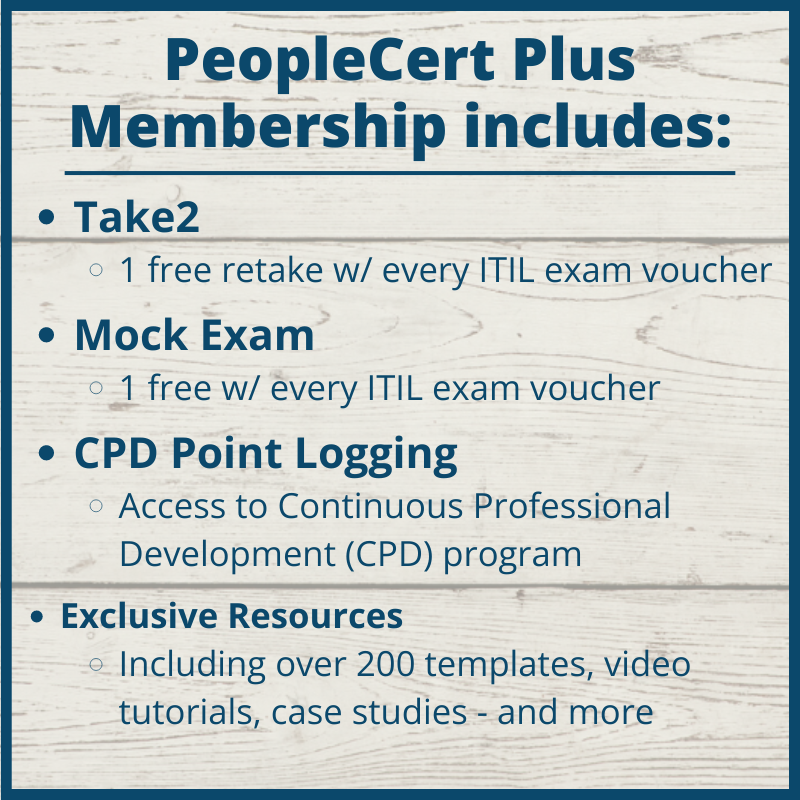
- PeopleCert Plus Annual Membership (not included in Epic class price, can be sourced from our website or by the learner directly from PeopleCert - the owners of ITIL.)
- Access to ITSM Academy's Learner Portal - my.itsmacademy.com - extends the classroom experience with online content and tools
Prerequisites
- ITIL 4 Foundation or ITIL (Version 5) Foundation
- Even if your ITIL Foundation certificate is expired, you can still attend any higher level ITIL (Version 5) course from ITSM Academy. Every successful pass of an ITIL PeopleCert exam will extend the previous expired certificates to the renewal date of the most recent ITIL PeopleCert exam.
- Attend accredited training course (mandatory)
- Complete pre-class reading assignment
- Familiarity with some aspect of IT management, product management, service management, or experience management is recommended.
Certification: Learners earn their ITIL (Version 5) Experience certificate by achieving a passing score (70%) on a 90-minute, 40-question open-book examination. Read more about the open book exam experience.
>>Official ITIL publications are available for learners who would like access to the reference materials for their open-book exam. You can purchase them here.<<

ITIL® is a registered trademark of the PeopleCert group. Used under licence from PeopleCert. All rights reserved. Used under licence from PeopleCert. All rights reserved.